Recipes from an Edwardian Country House

Recipes from an Edwardian Country House is a book that was repackaged from an earlier book. Frankly, I hate it when publishers do this sort of thing, as I often have the first book and then end up with another copy of the same book .

Seasonal Recipes From The Garden

For a long time my cable provider didn't provide a PBS station. It seemed weird, no PBS, but I learned to live it. After changing providers, I suddenly had PBS again.

Favorite Recipes of Famous Men

We are suckers for collections of recipes by "famous" folk. So naturally, Favorite Recipes of Famous Men a 1949 cookbook collection by Roy Ald is a great one.

Spoonbread and Strawberry Wine

There is not a single member of Norma Jean and Carole Darden's family that you want to hang out with. While most of them are gone now, they live on in this delightful cookbook and memoir.

Recipes from an Edwardian Country House

Recipes from an Edwardian Country House is a book that was repackaged from an earlier book. Frankly, I hate it when publishers do this sort of thing, as I often have

Saturday, July 31, 2010

Simple Fresh Southern

To give you an idea of how far behind I am... I went to see Matt and Ted Lee in April and I am just now writing about it.

The Lee Bros. were quite charming and proved that you don't have to be born in the South to be a Southern Gentleman. The Lee Bros. told stories of their love of food and talked a bit about searching through old cookbooks, which of course, is a favorite pastime here. I attended with Harry Lowe and both ANN(e)'s. Ann is a photographer who's work has graced the cover of Life Magazine but alas, she doesn't cook. Anne can cook but taking pictures with her nifty iPhone needs some work! Still, the Lee Bros. were game.

They were at the Smithsonian not only to talk about food, but also to sell their latest cookbook, Simple Fresh Southern. The pages are rich with lovely photos of drinks and salads and desserts. Not to despair, there are also a few fried items sprinkled here and there. Like most regional cuisine, "Southern" cooking is about as diverse as can be. When I cook, one of my goals is to take the essence of something traditional and serve it up in a unique way. The Lee Bros. have the same aesthetic in their cooking, which is why I always love to read their recipes and listen to them talk about food. If you haven't seen them "throwdown" with Bobby Flay making Country Captain, you must hunt it down and watch. (I won't spoil it by telling you the winner.) For that matter, why does Bobby Flay have two or three shows on TV and Lee Bros. don't???

They talked about the various methods of making collards, from the cooking for many hours version that is the traditional way to the quicker, dice and cook method. They also told a wonderful story about potlikker. Later I shared with them one of my favorite potlikker uses. You can check it out at Lucindaville.

When I ran across this dish in Simple Fresh Southern, I realized it was a similar to a dish a friend in Mississippi used to make. It was a wonderful potato dish that contained frozen potatoes, cheese, sour cream, mayonnaise and jarred peppers. It was a bit like watching sausage being made, you didn't really want to watch, but in the end, it was delicious.

This dish is not as dicey to watch being put together and it is, well -- simple, fresh and Southern.

Pimento-Cheese Potato Gratin

3 teaspoons salt, plus more to taste
1 1/2 pounds Yukon Gold potatoes, peeled and sliced into 1/4-inch-thick rounds
3/4 cup heavy cream
3 shallots, finely diced (scant 1/2 cup)
1/4 teaspoon crushed dried red chile flakes
1/2 teaspoon freshly ground black pepper
One 9-ounce jar roasted red peppers or piquillo peppers, with their liquid
8 ounces extra-sharp cheddar cheese, coarsely grated (about 2 cups)

1. Heat the oven to 375°F, with racks positioned in the middle and the top third of the oven.

2. In a 3- to 4-quart stockpot, bring 2 quarts water and 2 teaspoons of the salt to a boil. Add the potatoes, and cook for 10 minutes. Then drain, and set them aside.

3. Combine the cream, shallots, chile flakes, remaining 1 teaspoon salt, the black pepper, and 2 tablespoons of the liquid from the jar of roasted peppers in a small saucepan. Bring to a simmer, and cook until the chile flakes have begun to stain the cream, about 2 minutes. Add half of the cheese and stir until it melts, about 1 minute. Remove the pan from the heat.

4. Layer roughly a third of the potatoes in a 6-cup baking dish, overlapping them slightly so that they fit in an even layer. Scatter half of the roasted peppers on top of the potatoes (cut up any peppers that have remained whole so that they lie flat), and repeat layering potatoes and peppers until all the peppers and potatoes have been used. Pour the cream mixture over the potatoes and peppers, and agitate the dish to distribute the liquid throughout. Cover with aluminum foil, and bake on the middle rack for 15 minutes.

5. Uncover the dish, sprinkle the remaining cheese over the top, and place the dish on the top oven rack. Bake for 8 minutes, or until the cheese is bubbly and gently browned on top. Serve immediately.
The Lee Bros. refer to pimento-cheese as a Southern pâté. While we are on the subject of pimento-cheese...
it was always a staple in my house. Like many things, it fell out of favor, but came back with vengeance. Not just as a sandwich, but for me, a quick meal. Her are a few ideas:

I make pimento-cheese mashed potatoes -- throw a spoonful into the hot potatoes and mash.

Top some tortillas chips with pimento-cheese and some ground beef for a Southern twist on nachos.

Try mixing three cup of pimento-cheese into cooked macaroni and baking for a quick mac and pimento-cheese.

In July, Ann was visiting and she asked me to make a Tomato Pie. I asked her if she had read a recipe somewhere and she said no. She had just heard someone mention it and she wanted a savory tomato pie, because it sounded good. For a quick Tomato Pie, take a store-bought crust, layer it with sliced tomatoes and pimento-cheese, with the pimento-cheese last. Bake in a 375 oven for about 40 minutes.

Now I want you to drag out those old junior league cookbooks and find a recipe that you can update and make simple, fresh, and lovely.

Friday, July 30, 2010

Dolly's Dixie Fixin's


“I cook like an old mountain woman.”


Today’s joint venture with Famous Food Friday at Lucindaville is none other than Dolly Parton. I bet you didn’t even know she could cook. Sing yes. Act and write and run a theme park, yes. But cook? Well, she watched her Mama feed 12 kids in a tiny cabin, so some of that cooking had to rub off.


Dolly gathered up a whole bunch of recipes and wrote a cookbook, Dolly’s Dixie Fixin’s. The cookbook is filled with her Mama’s recipes as well as recipes from family and friends. There is a section on Christmas and other celebrations. Sections on barbeque, breads and sweets. Also, there a section called Road Kill that feature… not road kill, but recipes from some of Parton’s favorite roadside eateries like the Loveless Café and Mama Dips.

“…the two things I require in all my homes are a great kitchen and a chapel.”


Dolly’s Dixie Fixin’s follows the time-honored tradition in the South of gathering together collections of recipes to raise money for a church or a junior league. Parton’s cookbook raises money for a project close to her heart, Dolly Parton’s Imagination Library. In 1996, Parton began giving away books to children to spark their love of reading. She had a simple idea, give children, regardless of their family income, a book of their own every month. Parton personally sent a book every month to every child in Sevier County, Tennessee. The books begin with The Little Engine That Could and end, the month the child goes to kindergarten with, Look Out Kindergarten Here I Come. Needless to say, the idea caught on and before long there were Imagination Libraries popping up everywhere.


Like Dolly, food and reading are two of my favorite things.


Here is an appropriately titled recipe from Dolly. According to Parton:

“…when I stopped hoeing corn and working in the fields and moved to Nashville, I grew quite a bit larger. I was so fat, when I hauled ass I had to make two trips.”


These bars couldn’t be any sweeter. Just reading the recipe will make your teeth hurt.

Hello Dolly Bars

8 tablespoons (1 stick) butter, melted
1 cup graham cracker crumbs
1 cup chocolate chips
1 cup sweetened shredded coconut
1 cup chopped pecans
1 (14-ounce) can sweetened condensed milk

Preheat the oven to 350 F.

Pour the butter into an 8 by 8-inch baking pan. Spread the graham cracker crumbs in the bottom of the pan. Arrange the chocolate chips over the crumbs, followed by the coconut and pecans. Pour the condensed milk over the pecans. Bake until golden, about 20 minutes. The bars will not look like they’re cooked; they need to cool on a rack to firm up. Cut into bars once they are cooked.

I’m sure if you eat a big ol’ plate of these, you, too, will have to make a couple of trips to haul ass. And, if your community is looking for a fine project for children, look into the Imagination Library.

Wednesday, July 28, 2010

Cookery and Household Management


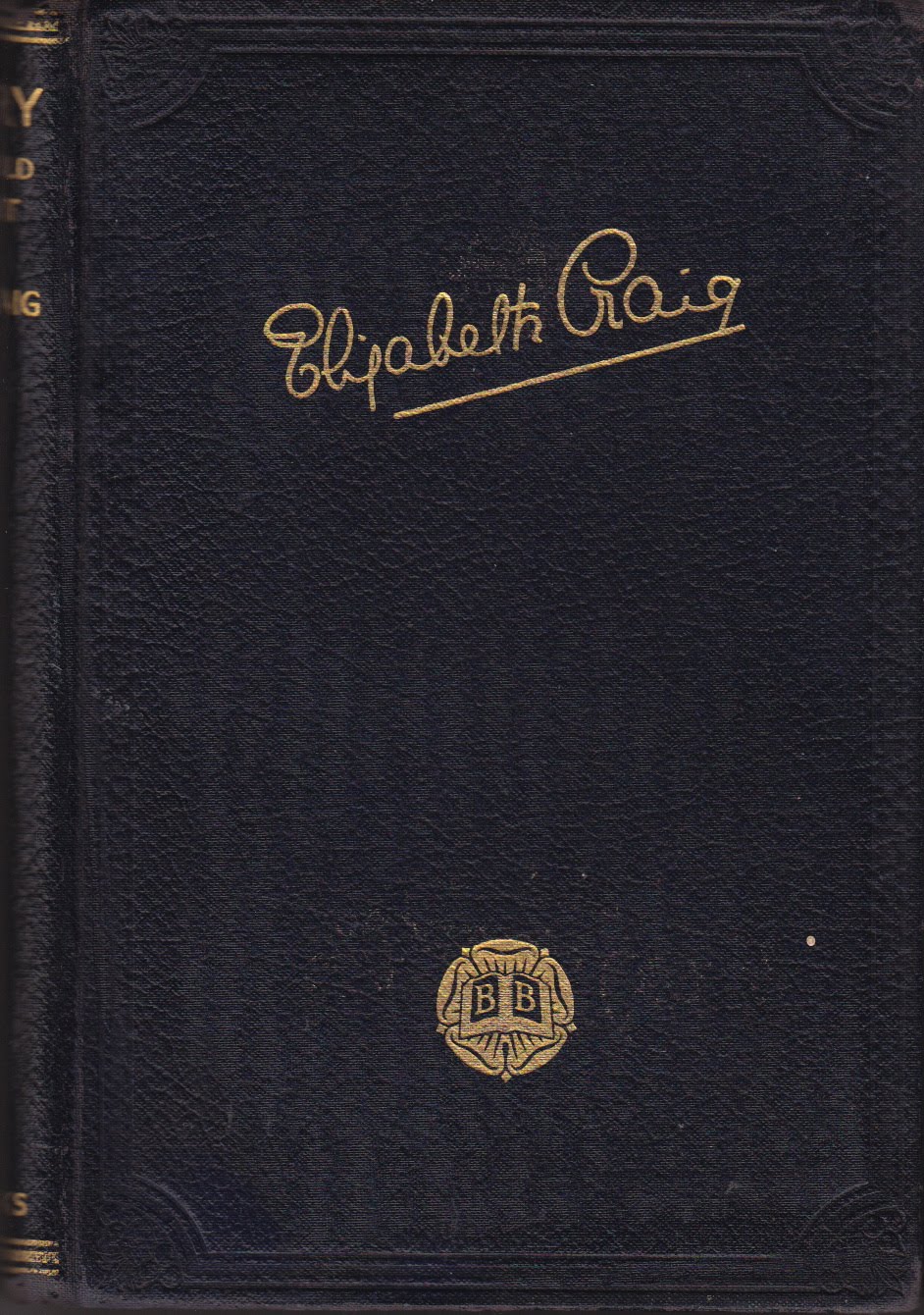
Elizabeth Craig was born in Scotland in 1883. She published her first cookery book in the 1920’s and her last in the 1980 when she was 97 years old. There is a famous story about Craig that I am sure I told you before, but it is worth repeating. Craig broke a hip and was lying in her hospital bed when her publishers suggesting that someone else should finish her next book. Craig would have none of it and has her notes brought into her and she finished the book by herself in the hospital.

You can’t keep a good woman down.

In fact, Elizabeth Craig wrote over 70 books on cookery and household management. She began publishing cookery books after the end of World War I when rationing was in effect and food items were often scarce. By the time her career ended, food was abundant and every home held a refrigerator. Her writing reflected this change in society.


In her two volume set, Cookery and Household Management, Craig offers up over 1000 recipes for entertaining and dining. Volume 1 is loaded with over 1000 recipes and Volume 2 offers up more recipes with household advice and management. The recipes in Volume 2 act as a kind of specialized instruction. There are recipes to lose weight, recipes for feeding invalids and one for feeding children.
There is a chapter on local (British) foods and a special selection of Jewish cuisine. There is wonderful chapter on The Empire Kitchen – food from Australia, Canada, New Zealand, India, South Africa and the West Indies, and though there is no true “Empire” left, it is fun to look at these disparate areas lumped together in a section of recipes.

I rather like this recipe because of the title, Shrimped Tomatoes. True, they are just tomatoes stuffed with shrimp, but stuffed tomatoes with shrimp just doesn’t have the cache of “Shrimped Tomatoes.” It is probable important to point out that the shrimp stuffing these tomatoes are brown shrimp, tiny little shrimp you don’t find too much in America. Americans like “jumbo” shrimp which a proper Empire Kitchen would refer to as a “prawn” which is technically or should I say biologically different from a shrimp as they belong to different suborders of Decapoda, but I digress…

Shrimped Tomatoes

2 large British Tomatoes
1/2 pint of shrimp
1oz. Breadcrumbs
1 egg

Utensils – Knife, grater, egg-beater, basin, kitchen spoon, baking tin.

Cut the tomatoes in half and remove some pulp. Add the breadcrumbs and shrimp to the beaten egg, then place the mixture on each half tomato. Cook in a moderate oven until the tomato is soft.


Check out Lucindaville’s Etiquette Wednesday to find a few of Elizabeth Craig’s household hints.

Wednesday, July 21, 2010

Picnics


I love picnics. Though I must admit, I have never really found a picnic book that I adore, completely. Picnics, by Sara Deseran, is one of the best little picnic books. It offers a nice mix of recipes and heaping helpings of picnic advice. There is a list of items to bring to the picnic. How frustrating can it be to arrive at a lovely picnic area and realize that you have no corkscrew?

Deseran adds a menu section in the back of the book. She takes recipes from the book and arranges them into events like a City Picnic, an Elegant Brunch, or a Latin Barbeque. The menus are a nice touch.

I am a huge fan of orzo and it rarely shows up in cookbooks. For my money, it is versatile, easy to use, and downright tasty. Picnics offers up a great orzo salad.


Orzo Salad with Green Olives, Tomatoes, and Feta

1 pound uncooked orzo (2 generous cups)
1/4 cup olive oil
2 pounds cherry tomatoes, in an assortment of colors, halved
2 teaspoons kosher salt
1 English cucumbers, unpeeled, quartered lengthwise and cut into slices
1 cup chopped red onions
1 cup (about 5 ounces) feta cheese, crumbled
3/4 cup green olives, halved
1/2 cup chopped fresh Italian parsley
1/4 cup freshly squeezed lemon juice
1/2 teaspoon freshly ground black pepper


Bring a large pot of salted water to a boil. Add the orzo and cook until just tender, about 8 minutes. Drain. Rinse with cold water and drain again. Add 2 tablespoons of the olive oil and mix well. Set aside.

Put the tomatoes in a large bowl and add 1 teaspoon salt. Let stand for 1/2 hour or so and then drain any accumulated liquid. Add the cucumber, red onion, feta, olives, parsley, lemon juice and the remaining 2 tablespoons olive oil and gently mix. Add the orzo and gently toss with the vegetables. Season with the remaining salt and the pepper. Cover and refrigerate until ready to serve.


Mix up a big batch and head outside.

Tuesday, July 20, 2010

Cooking In Provence


I know, I know, I don’t need another cookbook about Provence. There are clafouti, and moules and tomato tarts, oh my. Still, there has never been a Provence cookbook I didn’t love and Alex Mackay’s Cooking In Provence is no different. I can’t help myself, but French food just looks better than any food on the page. How is that possible? I don’t know, but it is a fact. Rather than palaver on, take a look at the food.


and

and


Oh yeah, here is the recipe.


Coeur A La Crème

350 g (12 oz) fromage frais
200 g (7 oz) caster sugar
Juice of 1 lemon
250 g (9 oz) raspberries
300 g (10 1/2 oz) or 2 large punnets, of either raspberries, strawberries or red currants, or a mixture
100 ml (3 1/2 fl oz) double cream or crème frâiche (optional)

Line a heart, or any perforated mould – the base of a small colander would do – with a layer of muslin. Mix the fresh cheese with half the sugar and the lemon juice and spoon it into the muslin and mould, being careful not to crease the muslin too much. Tap the mould against the table a few times to knock out any air bubbles and leave to drain for at least 2 hours.

Mix the first 250 g (9oz) raspberries with the remaining sugar and 100 ml (3 1/2 fl oz) water in a small pan. Bring to a boil, purée and strain, and mix the remaining fruit.

To serve, unmould the cheese heart, warm the berries in the coulis and help yourself to the double cream.


I think coeur a la crème is a wonderful, and lovely dessert. It is quite easy to make and tasty. I am resolving to make it at least twice this summer!

Monday, July 19, 2010

Cider Beans, Wild Greens and Dandelion Jelly


Joan E. Aller has written a book about cooking in Southern Appalachia, Cider Beans, Wild Greens and Dandelion Jelly. The exact “region” covered by Appalachia is a bit fluid. Generally Appalachia runs from middle-eastern Mississippi, through middle Alabama, north Georgia, western Virginia, Maryland, South and North Carolina, eastern Tennessee and Kentucky, southern Pennsylvania and most of West Virginia.

Aller moved to the Tennessee Mountains and fell in love with the culture. She began gathering recipes from the region. The focus is the area around her, Tennessee, Georgia and North Carolina. She mixes traditional recipes with recipes from a growing number of bed and breakfast inns throughout the area. That means that Ramps and Bacon show up along side Warm Camembert Salad with Apples and Walnuts; Hot Artichoke Dip finds itself with Shrimp and Grits.

Aller has studied the historical background of the area, tracing the Cherokee to the Melungeons to the Africans to the Europeans to the owners of Bed and Breakfasts. Each migration brought new foods and twists on the native flora and fauna.

The Melungeons were a strange sect, probably descended from Berber Muslims and Sephardic Jews fleeing the Spanish Inquisition. Immigrating to the new world on Portuguese ships. They settled in the mountains of Appalachia, keeping to themselves. As more Europeans arrived, the Melungeons pushed further and further into the hills. With no written language of their own, they became almost a myth in the area, their very name used to keep children in line. There is a recipe for Melungeon friendship bread, a tradition carried on by the Amish. The bread is nurtured for 22 days, and then baked. Along with a loaf of bread, the recipient gets a bag of starter to keep the bread moving. As someone who has made and passed on friendship bread, I have to say the intent is noble but the thought of having to spend 22 days getting more starter ready to bake can be a trial. Pretty soon, people begin to hide when they see you coming with bread and that ubiquitous bag of starter.

One of my favorite recipes from Appalachia is for honey cream. It is not something you see too often, but it really should be a staple in every kitchen. Serve it on pancakes, cornbread or fry bread. It works on fruit, too.
Tennessee Honey Cream

2 cups heavy cream
2 teaspoons honey

In a medium bowl using a stand mixer, beat the cream on medium speed until it begins to thicken. Drizzle in the honey and continue to beat until the whipped cream is thick.

This is a great addition to Southern cuisine and the history of regional cooking.

Sunday, July 18, 2010

Edible


One day Tracey Ryder and Carole Topalian compiled a little newsletter about food in Ojai. They dubbed it Edible Ojai and for a couple of years they toiled in not quite obscurity. Noticed by Saveur, Edible Ojai was featured in their top 100 for 2004. In the tiny blurb, the authors expressed a desire for their concept to, “crop up everywhere.” Be careful what you wish for!

Over the next few years about 60 local “edibles” sprang up; from Ojai to Boston, from Portland to Orlando and my closest -- Edible Allegheny.


It was only natural to envision a cookbook culled from all those “edible” editions celebrating local foods, farmers and artisans. Actually, like most of their publications, Edible is more than a cookbook, it is a hymn to those local individuals who have dedicated their lives to producing, maintaining, and promoting local foods.


Here’s a recipe from Edible Memphis.

Collard Tops with Parmigiano

1 bunch (about 1 1/4 pounds) collard tops or broccoli rabe (including flowers and stems), coarsely chopped
2 tablespoons unsalted butter
1 clove garlic, thinly sliced
1/2 cup heavy cream or half-and-half
1/2 cup freshly grated Parmigiano-Reggiano
1/2 teaspoon kosher salt
1/4 teaspoon freshly ground pepper

Preheat the oven to 350 f. Have a large bowl of ice water ready. In a large saucepan of boiling salted water, blanch (partially cook) the collards until bright green and slightly tender, about 2 minutes. In a colander, drain the collards, then plunge the greens into the ice water. Drain well and squeeze dry; set aside.


In the same saucepan, melt the butter over medium-low heat. Add the garlic and cook until it is tender but not browned, about 2 minutes. Stir in the cream. Increase the heat to medium-high and cook until slightly thickened, 1 to 2 minutes.

Lightly grease a 1-quart casserole pan. In a medium bowl, combine the collards, cream mixture, cheese, salt, and pepper. Spread the mixture evenly into the baking pan. Cover with the lid or foil and bake until the cheese is melted, 15 to 20 minutes. Serve immediately.
For someone who always saw collards cooked for at least 2 hours, this is a great way to cook them quickly.

Check out the Edible Communications web site to find an Edible publication in your area. If there isn’t one… you know you always wanted to be magazine publisher!

Saturday, July 17, 2010

Cooking With My Sisters


Adriana Trigiani is a best-selling novelist. She immortalized her home in the Virginia hills, Big Stone Gap. Her books are filled with family and a strong sense of place, so it is only natural that her cookbook, Cooking With My Sisters, is, too. She grew up in a household with six children, four girls and two boys. They were a large Italian, Catholic family in the Baptist South of Virginia.

Trigiani tells of the first time they were fed “spaghetti” at school, an event she described as “shocking.”

"The noodles were boiled until you could see though them and then sloshed with sloppy joe mix, heavy on the ground hamburger. We did our best to swing the cafeteria staff toward authentic Eye-talian (as they put it,) but we gave up when they insisted that all spaghetti sauce needs is a base of chopped meat, a cup of ketchup, and a shot of chili powder."

It is a story I know too well. When I went to school in the North (South Dakota, so maybe still in the South.) I remember being served “cornbread.” Though it was not cornbread, but rather an overcooked, slightly crusty yellow cake, sweet and sticky and nothing close to my Mother’s cornbread. I was horrified.

Culture shock is a bitch!

Trigiani book is filled with stories and recipes, with a plethora of "notes" from her sisters. Here is a family recipe for cookies, but not the sweet kind, the small savory bites known as Taralli. A perfect compliment to a glass of wine with sisters.

Savory Taralli

1/2 packet (1 1/4 teaspoons) active dry yeast
1/4 cup lukewarm water (105 –110 degrees)
3/4 cup vegetable oil
2 eggs, lightly beaten
1 teaspoon salt
1 tablespoon fennel seed
4 cups all-purpose flour
In a large bowl, dissolve the yeast in the lukewarm water and allow to bubble. Add the rest of the ingredients, except the flour, to the yeast mixture. Add the flour and mix well.

Preheat the oven to 350 degrees.

Take a piece of dough ant roll it between your hands, making a pencil-like shape 4 to 5 inches long. Create a circle by joining the ends together and pinching them closed. Place on a greased cookie sheet and bake for about 8 minutes, or until golden brown.


Adriana Trigiani brings the same love of family and language to her cooking as she does to her novels.

Friday, July 16, 2010

Singers & Swingers In The Kitchen


Today’s Famous Food moment is a blast from the past -- the groovy, swinging sixties! In 1967, this slim volume gathered together a group of famous and not “scene-makers”.

It features, according to the cover, “dozens of nutty, turned-on, easy-to-prepare recipes from the grooviest gourmets happening.” On the back cover: “Dig the sounds… in the kitchen. They’re hip, mod, delicious recipes from today’s top scene-makers…”

Who are these “scene-makers”? Well, some you know – the Rolling Stones – and some – The Cyrkle – are clearly no longer making the “scene.” There is Omar Sharif sharing his Southern Fried Chicken recipe. No offence but I’m not sure I want Omar Sharif making fried chicken! There are the Buckingham’s long before Lindsay ever saw Stevie Nicks. There is Don Adams and an entry by Sybil Burton Christopher, who was Richard Burton’s wife before Elizabeth Taylor. After she was dumped by Burton she moved to Manhattan, opened a boutique and, if this little cookbook is any indication, made the “scene.” (She is also the mother of Kate Burton who played Ellis Grey, who was the mother of Meredith Grey, played by Ellen Pompeo in Grey’s Anatomy. So, in some way, that makes Sybil the de facto “grandmother” of Meredith Grey, or maybe not… I digress.)

As you can see from these page, no expense was spared in the production of this book!

Here are just a few of the groovy dishes one might find oneself eating while making the scene.


Hot Dogs On the Rocks
(serves 5 Stones)

10 frankfurters
5 potatoes, or enough instant mashed potatoes to serve five
1 large can baked beans

Prepare the instant mashed potatoes, or boil and mash the potatoes. (Use milk and butter, making regular, every-day mashed potatoes.) Cook the frankfurters according to the package directions and heat the baked beans.

On each plate, serve a mound of creamy mashed potatoes ringed by heated canned baked beans. Over the top of all this, slice up the frankfurters in good-sized chunks.

Mick supposedly “invented” this dish with Charlie Watts adding in the canned beans.

When I think of the iconic, swinging sixties scene, one name always comes to mind – Leonard Nimoy. This is a fab first course invented by Nimoy, himself.


Cold Soup Nimoy

2 cans cream of celery soup
2 cans cold water
1/4 pint sour cream
Juice of 1 lemon
1 cucumber, chopped
3 scallions, chopped
1 green pepper, chopped
Seasoned salt (or salt) and pepper

Mix he soup, water, sour cream, lemon juice and seasoning, and beat with an egg beater. Stir in chopped vegetables. Chill and serve in cold soup bowls. (It is especially nice if you can let it chill overnight.)

How fab is that. Canned soup chilled! Overnight.


Finally, for all my blog readers, a third recipe from a triple threat – one Barbra Streisand. In 1967 she was an actress, a singing star, and now a mother. According to Singer & Swingers, Streisand took up cooking when she went into retirement. (The first of many retirements in Bab’s history.) This recipe is for her invention she calls instant ice cream.


Barbra’s Instant Coffee Ice Cream

24 marshmallows
1 cup milk
1 teaspoon instant coffee
1 cup heavy cream

Turn your refrigerator to the coldest point. Pour milk into a saucepan, heat, and gradually add the marshmallows. Mix until the mixture is smooth; add the instant coffee. Let it cool a bit. Whip the cream until stiff; mix cream and marshmallow mix together and pour into and empty ice cube tray. Freeze.

Barbra likes it with pretzels. Believe it or not.

Seriously, with this cookbook I’ll believe anything.

Might I suggest that you gather your friends to make the scene? You can be the swinger who whips up dinner. Start with Cold Soup Nimoy (Don’t forget to chill it overnight.) For the main course Hot Dogs on the Rocks finished up with Barbra’s Instant Coffee Ice Cream with a side of pretzels, just like Barbra!

No doubt you will be the most fab foodie on the block!

Thursday, July 15, 2010

Canal House Cooking


Christopher Hirsheimer and Melissa Hamilton were two gals with cool food careers. Hirsheimer was one of the founders of Saveur magazine. She was a food and design editor at Metropolitan Home. As a photographer, she takes classic and inviting images of food and its surroundings. Hamilton worked at Martha Stewart Living, Cook’s Illustrated, and at Saveur. She co-founded the Restaurant Hamilton’s Grill Room and served as the executive chef. So what did they do when they decided to leave the corporate magazine world? They started a magazine/book kind of thing.


As an editor of a literary magazine, I follow the comings and goings of literary start-ups, so why not do give recipes the same treatment as short fiction or poetry. Hirsheimer and Hamilton rented a studio in a red brick building on a canal, added a couple of small stoves, some pots and pans and a bit of olive oil and Canal House Cooking was founded.

Basically, they meet in the morning, make some coffee, tell each other what they had for dinner and then cook all day. Sounds like a plan. Three times a year, they publish a magazine in the form of a literary magazine that is chocked full or seasonal recipes.

From Issue #1

Potato Salad “Buttered” And Lemoned

Assemble the salad while the potatoes are still warm allows them to absorb the flavors of all the “fixins”.

2-3 pounds potatoes, any variety will do
Salt
1 cup mayonnaise
1/2 cup rally good extra-virgin olive oil
Pepper
Rind from 1 preserved lemon, chopped
Chopped fresh chives or parsley

Peel the potatoes if you use a thick-skinned variety or if you simply prefer peeled potatoes for this dish. Put the potatoes in a large pot of cold water generously seasoned with salt. Bring to a boil over medium-high heat and cook until they are tender. Drain.

When they are cool enough to handle, slice the potatoes and arrange them on a serving platter, “buttering” one side with some of the mayonnaise as you work. Drizzle the potatoes with the olive oil, season them with salt and pepper, and garnish the potatoes with the preserved lemons and chives.

Not only do the girls cook, but they lift a glass, too. And the population of Lucindaville loves to lift a glass. Here is a libation from the current Issue #4. The recipe was sent in by a supported to help with a deadline. Though, it might just make you miss a deadline or two.


The Arturo

Pour 1 tablespoon real maple syrup and the juice of a hand-squeezed, fat, thin-skinned lime into a glass. Add 2 ounces Mount Gay Eclipse rum and stir to mix. Fill the glass with cracked ice then float Zaya Grand Reserva rum or Rhum Barbanbcourt (15 year) on top.


If you subscribe to cooking magazines, here’s one without the ads, just great recipes and beautiful photos. Check out their website: thecanalhouse.com.

Wednesday, July 14, 2010

OMG -- The Satellite CRASHED


We didn't quite blogging...the hardware just stopped us from uploading. It stopped us from downloading.
Frankly we were just stopped. And it was devastating.

Tomorrow we will begin loading all the stuff we couldn't.

And getting back to reading everyone else -- We MISSED you!!!

Tuesday, June 22, 2010

A Man's Cookbook


One of the big stars of French culinary television was Raymond Oliver. He owned the three star restaurant, LeGrand Vefour, a truly legendary establishment. Kind of like James Beard, he has fallen a bit out of style in modern day culinary adventures. He is probably best known in America for his participation as one of the eleven judges at the Judgement of Paris, made famous in the movie, Bottle Shock.

In the late 1950's he wrote a book on cooking for men -- or a cookbook aimed at men -- to get them to cook -- for themselves. OK it sounds a bit more complicated than it should be. It was a guy's cookbook by snotty French chef. It made it to America in 1961 as A Man's Cookbook.

The book is a wonderful period piece complete with small black and white drawings of food items. He gives basic info on how to cook on a gas stove, an electric stove and the ever-present wood and coal range, which should give you some idea of how old this book is!

Above all, Oliver is a French Chef in the heyday of French cuisine. That means that he is not adverse to include a recipe for oeuf en gelée, which I always think of a a dish for a man's man. So how about pig's feet?

Pig's Feet
Les pieds de porc

Split in half, these are excellent pan-fried in bread crumbs or broiled. They may be truffled, that is, served with slices of truffles. Cook them in a well seasoned bouillon, drain them, and let them cool pressed between two planks. Once they are cold, cut them lengthwise, cover with bread crumbs, and broil. Serve very hot.


Or you could just have an oeuf en gelée.

Saturday, June 19, 2010

The Forgotten Art of Flower Cookery

I know you think there was never a cookbook I didn't lust after. I must admit a certain fascination with flower cookbooks. There is something I just adore about cooking with flowers as an elemental ingredient. Maybe, and I the first to admit it, there is a profoundly prissy element to flowers as an ingredient. while nothing makes me happier than a side of beef, I also love a nice cold soup sprinkled with a "mystery" ingredient that came from the flower garden.

The Forgotten Art of Flower Cookery by Leona Smith is from the early 1970's. Smith was considered the leading authority on flower cookery. Truth be told, in many of the recipes, the flower element seems to be just a garnish, but in this day and age of cooks all trying to trump each other in the exotic ingredient department, some nice pickled carnations might be just the ticket to one-upsmanship.

Every Thanksgiving, tables across America are laden with sweet potatoes. Here is a recipe that will make you the talk of Thanksgiving or even The Fourth of July!

Confucius Sweet Potatoes
1 pound sweet potatoes or 1 seventeen-ounce can
1 cup orange juice
1 three-ounce package of orange gelatin
1/4 cup brown sugar
2 tablespoons butter
Salt and pepper to taste
1 cup yellow chrysanthemum petals

While the sweet potatoes are cooking (if using raw potatoes) combine all other ingredients except petals. Simmer and stir for 5 minutes.

Place sweet potatoes in the syrup ad let stand over the lowest possible heat for 15-20 minutes. Baste occasionally. Turn off heat, add petals, and baste until petals are glazed.

Once I found myself in an unfamiliar kitchen. I was making some carrots, but there was nothing interesting to flavor them with, so I was facing a bowl of steamed carrot. (OK, not the worst thing in the world.) I noticed a package of orange Jello on the shelf. I added the Jello and some butter to the carrot circles and turned out a truly tasty and interesting carrot dish.

Confucius says: When in doubt check the larder and the flower garden!

Friday, June 18, 2010

“As We Like It” Cookery Recipes by Famous People


Our recipe today comes from Freya Stark.

Books are very important. How many stories of fascinating people begin with a book they received as a child? Freya Stark is no different. On her 9th birthday she received a copy of The Thousand on One Nights. After reading it, she became fascinated with the Orient and by the late 1920's she was in Baghdad.


The truth is, by 1927, when Stark headed for the Middle East most of the world had already been discovered. But Stark set out, often alone, heading to remote locations where no European woman had ever traveled. In Iran she located the fabled Valley of the Assassins.

Pool in Sayyid Abu Bakr al-Kaf's garden, Seiyun 1938

Stark wrote extensively of her travels, publishing her first book, Baghdad Sketches in 1932. Over the next fifty years she would write 24 travel books and autobiographies and eight volumes of letters. After her death, her godson,Malise Ruthven, published a collection of her photographs from Southern Arabia.

South gate, Tarim 1935

In 1950 there were approximately 7500 disabled soldiers among the 60,000 in the Returned British Prisoners of War Association. They were in need of some extra help, so a big group of “famous” people got together and compiled a cookbook to provide extra funds to those who needed it. The cookbook, “As We Like It” Cookery Recipes by Famous People contains recipes by the likes of Noel Coward, Enid Blyton, Richard Attenborough, a big bunch of sirs and ladies and viscountesses thrown in for good measure. The recipes are generally simple but I doubt there was much testing on these recipes. Still, it is fun to see the recipes chosen by some names you know.

While Stark looked like she never missed a meal, wandering about the backdeserts of Syria couldn’t be that conducive to finding a 7-11. Come to think of it, finding a nice cut of beef and a stewpan while hunting assassins in Persia couldn’t have been easy. Being a writer, one would think that Stark might have come up with a zippier title for the dish than, Economical Recipe for Meat. Really, it’s just mom’s pot roast, slowly braised. Quite divine.

Economical Recipe for Meat

Take a boneless piece of beef and put it in a stewpan into which it just fits easily. Cut up a sufficient number of raw onions to fill in every cranny round the meat. Add salt and pepper, and nothing else. Put a weight on the lid of the stewpan to prevent any steam from escaping and cook over a slow fire. It will make an excellent dish and the onion juice will all be absorbed.


My favorite photo of Stark on a picnic outside of Baghdad.
Notice her "picnic box."

Stark wrote, "To awaken quite alone in a strange town is one of the pleasantest sensations in the world." Still traveling in her 90's, a reporter asked her about death and she replied,
"I feel about it as about the first ball, or the first meet of hounds, anxious as to whether one will get it right, and timid and inexperienced -- all the feelings of youth."

Freya Stark died at 100.


For a comprehensive look at the life of Freya Stark check out Passionate Nomad: The Life of Freya Stark by Jane Geniesse.

Thursday, June 17, 2010

Delights and Prejudices


Delights and Prejudices was written by James Beard in 1964. The book is filled with over 250 recipes, but each of them is sandwiched in the context of a larger work of memoir. On can never truly extricate themselves from their first kitchen and Beard is no exception. He grew up in the kitchen of his mother who cooked for several hotels in Portland, Oregon. While Beard fell in love with French cuisine, he never strayed from the locally grown produce and fresh ingredients that filled his mother's kitchen.

A newer edition of this title was published in 2001 with an introduction by Julia Child and a foreword by Charlie Trotter. James Beard has fallen out of fashion a bit in recent memory, but this is just the book to bring him back with a vengeance. What makes this book so marvelous is the way the talks about the food. Yes, the recipes are important, but they merely lay a framework for a larger story -- the story of a man who truly loves food and the people who grow it and cook it and sell it and share it.

Huckleberry Cake was a Beard favorite. He adapted his recipe from an old family recipe of Mary Hamblet, a lifelong friend to whom Beard dedicated the book. In some circles it is still referred to as the Hamblet Huckleberry Cake. Huckleberry Cake often has an asterisk stating that blueberries will make a fine substitution. If you believe that then you desperately need to read Delights and Prejudices. Beard makes it clear that only the tart, elusive huckleberry will give this cake the true flavor of the Northeast. (That being said, many of the blueberries that hit the supermarket from foreign lands are picked at a point that they are almost as tart as the precious huckleberry. On rare occasions, huckleberries turn up in the freezer case at a supermarket. If you want huckleberry cake, you need the huckleberry. But feel free to make a Blueberry Cake if you must, Beard won't mind.)

This edition of the book features recipes written like I like to read them -- with the ingredients incorporated into the method.

Huckleberry Cake

Cream 1 cup butter and 1 cup granulated sugar together until the mixture is very light. Add 3 eggs, one by one, beating after each addition. Sift 2 cups flour and save 1/4 cup flour to mix with 1 cup huckleberries. Add to the rest 2 teaspoons baking powder and a pinch of salt, and fold this into the egg mixture. Add 1 teaspoon vanilla and, lastly, fold in the floured huckleberries. Pour the batter into a buttered, floured 8-inch-square baking tin. Bake at 375º for 35 to 40 minutes or until the cake is nicely browned, or when a tester inserted comes out clean. Serve the cake hot with whipped cream, or cold.

On the James Beard foundation website, they have the recipe converted to a modern layout.

Huckleberry Cake

Ingredients:

1 cup butter
1 cup granulated sugar
3 eggs
2 cups all-purpose flour, sifted
1 cup huckleberries
2 teaspoons baking powder
Pinch of salt
1 teaspoon vanilla extract

Method:
Preheat oven to 375º.

Cream butter and sugar together until the mixture is very light. Add eggs, one by one, beating after each addition. Combine 1/4 cup flour with the huckleberries. In a bowl, mix the remaining flour with baking soda and then fold this into the egg mixture. Add vanilla and, lastly, fold in the floured huckleberries.

Pour the batter into a buttered, floured 8-inch-square baking tin. Bake for 35 to 40 minutes or until the cake is nicely browned, or when a tester inserted comes out clean. Serve the cake hot with whipped cream.

Give this one a try and if you have never read James Beard, this is the place to start, and that is my prejudice.

Wednesday, June 16, 2010

The Robert E. Lee Family Cooking and Housekeeping Book


Having a pile of family recipes is a lovely thing but usually a family thing. What happens when you find yourself with a pile of recipes attributed to the family of Robert E. Lee? That was the dilemma faced by Anne Carter Zimmer. Zimmer is the great-granddaughter of Robert Edward and Mary Custis Lee and her maternal grandfather was Robert E. Lee Jr.

As a child, Zimmer, like most self-conscious teenagers, was slightly embarrassed be the family connection. As she grew up, she realized the importance of her heritage and realized that her family recipes were more than just an assemblage of household tips, but a historical record beyond the scope of her immediate family.

A page from the collection featuring a Sally Lund Cake

She set out to translate the fragmented recipes and advice into a workable collection of recipes for the modern cook, enlisting a group of cooks to test and re-test the recipes while she searched for the family significance of each recipe. It was not always an easy task.

‘Sometimes what we did was more treasure hunt than testing, and occasionally serendipity served us well. "Butter the size of a goose egg" was an easy measurement to track down, because somebody's sister-in-law raised geese. But the size of a "bottle of oil" remained questionable and a "dripping box of flour," impossible to determine. Two receipts for caromels [sic] made a primitive chocolate fudge that either crumbled or relaxed into puddles; only later would I puzzle out why. And eventually I learned (from an eighteenth-century source) to make boiled puddings, but only after producing ugly, gluey concoctions that looked, as one helpful tester remarked, "like a brain."”

The result is the The Robert E. Lee Family Cooking and Housekeeping Book, a cookbook/history of days gone by. Since it is summer and since it is miserably hot, we felt that a refreshing drink from Robert E. Lee might be just the ticket. (Now we know that being a boy and being a general, Robert E. Lee most probably never lifted his hand to make a drink or food, but we are giving him credit anyway.)

Robert E. Lee's camp cooking kit


Roman Punch

Juice of 5-6 lemons
3 cups sugar
1 cup (8 ounces) currant jelly
2 quarts minus 1/2 cup water
1 cup brandy
2/3 cup black rum
About 5-6 tablespoons or bags of green (or black) tea

Heat about half the water with sugar and jelly, stirring to dissolve. Make tea with the rest. Combine the two mixtures. Cool, add lemon juice, brandy, and rum. Ripen overnight at room temperature or up to 3 days in refrigerator, then freeze if you like. Makes about a gallon.


Time to gather around the Burn Pit (actually, gathering around the air conditioner might be more fun) and lift a glass to the Confederate Dead, or to Wednesday. It doesn't matter as long as you are lifting a glass!