Recipes from an Edwardian Country House

Recipes from an Edwardian Country House is a book that was repackaged from an earlier book. Frankly, I hate it when publishers do this sort of thing, as I often have the first book and then end up with another copy of the same book .

Seasonal Recipes From The Garden

For a long time my cable provider didn't provide a PBS station. It seemed weird, no PBS, but I learned to live it. After changing providers, I suddenly had PBS again.

Favorite Recipes of Famous Men

We are suckers for collections of recipes by "famous" folk. So naturally, Favorite Recipes of Famous Men a 1949 cookbook collection by Roy Ald is a great one.

Spoonbread and Strawberry Wine

There is not a single member of Norma Jean and Carole Darden's family that you want to hang out with. While most of them are gone now, they live on in this delightful cookbook and memoir.

Recipes from an Edwardian Country House

Recipes from an Edwardian Country House is a book that was repackaged from an earlier book. Frankly, I hate it when publishers do this sort of thing, as I often have

Showing posts with label Soul Food. Show all posts

Monday, July 28, 2014

Soul Food

Soul food is like pornography, you know it when you see it.

But very often, seeing it and explaining it are not mutually inclusive.  Then Adrian Miller came along with his book Soul Food.  Miller is about as good as anyone at explaining what soul food is and why it is so important.  This is especially necessary at a time when "Southern cooking" is becoming so prevalent that every city from Juno to Jackson Hole thinks they can throw a piece of chicken on a plate with some greens and claim to be soulful!

Readers of this blog know that my "go to" guide for soulful, Southern is Granny Clampett from the Beverly Hillbillies, who knew a thing or two about chitlins, grits, and crawdads. Food used as fodder for jokes in the 1960's now finds its way to restaurants across the country. (and before you e-mail, yes, I know that Granny was actually Daisy Moses, a Clampett in-law and not an actual Clampett, but she was often referred to as Granny Clampett.  Let me also say that I am delighted to find so many Beverly Hillbillies sticklers out there, but I digress...)

It is hard to extricate food, class and race from discussions of soul food.  It is very easy for these issues to be glossed over or generalized to the point of common clichés.  It is the great strength of Soul Food to move the discussion forward.  Miller acknowledges the easy generalizations.  He addresses them, then shifts the discussion to  a larger context, both historical and culinary.  His chapter on chitlins is a prime example.  Walk into an old-fashioned Southern, soul food, "meat and three" restaurant in the South and the food will be remarkably similar.  However, one can tell immediately if the owner is African-American by the inclusion of a single dish -- chitlins.

Miller points out that the "face" of nose-to-tail cooking is a Brit, Fergus Henderson.  Henderson has been lauded for his revolutionary approach to eating whole animals, but a subway ride to Harlem (or a drive to any Southern city) would turn up dozens of cooks using snouts, ears, intestines, and tails.  (Once again, I digress but if Daniel Boulud would put squirrel on his menu, just saying...)

Miller dispels that common notion of "white folks wouldn't eat it" by pointing out that chitlins were considered rather high end cooking to the likes of Hannah Glasse.  Still, for both races in the South, there is a classist stigma to eating chitlins.  Of course, that same classist mentality was prevalent in West Virginia where children were laughed at for eating ramps which are now selling for $15 a pound in Brooklyn. 

Historic nineteenth-century Southern cookbooks were devoid of chitlin recipes regardless the race of the author.  Miller finds chitlins recipes in Freda DeKnight's 1948  A Date With A Dish. Miller notes that while DeKnight offers introductions to other recipes, there are no headnotes to the chitlin recipes.  (I cannot confirm this as A Date With A Dish is a book I have been searching for in it's jacked, first printing, but when I find it it is always out of my price range, but again, I digress...)

Miller writes:

"Chitlin eating among whites went private or entirely underground..."

I know that when I go to the Florida Avenue Grill and order chitlins, there is a a definite pause before taking my order.  While I haven't cooked chitlins, I have watched my Mother cook them.  I don't recall either experience being private or underground, but who knows? 
 I say screw class, screw race, lets all get together for a big old chitlin whoop-de-do.  

But first, you need to grab a copy of Soul Food, the worthy winner of a James Beard Award.  And for more info check out Adrian Miller's blog.
Wednesday, January 12, 2011

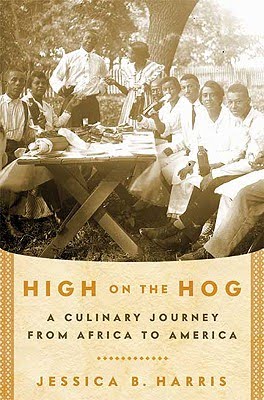
High On The Hog


To say that Jessica B. Harris writes “cookbooks” would be a grievous understatement. She does write cookbooks but she a masterful practitioner of culinary history. There is that derogatory adage which states those who can do and those who can’t teach. Jessica B. Harris can both cook and teach.

Here new book was receiving accolades even before it was officially published. High on the Hog is a narrative of African American foods history told from one table to another.

It is easy to forget that the African Diaspora brought with it many of the foodways that most people think of as truly American. When looking at one of America’s earliest and most influential cookbooks, 1824’s Mary Randolph’s The Virginia House-wife, featured ingredients that simply hadn’t existed in America a hundred years earlier such as field peas and okra. It would be three years later when the first African-American published a book with recipes, Robert Roberts’ The House Servant’s Directory.

It would be inconceivable to think that there is a person interested in American cuisine and Southern cuisine especially, that wouldn’t benefit from a careful reading of Jessica B. Harris’ High On The Hog.

Though there are only a few recipes in her book, this one from her Grandma Harris is sure to be a winner.

Grandma Harris’s Greens

4 pounds of mixed collard, mustard, and turnip greens
8 strips of bacon
6 cups water
Salt and freshly ground black pepper to taste

For serving:
Hot sauce
Chopped onions
Balsamic vinegar

Wash the greens well, picking them over to remove any brown spots or blemishes, then drain them well, cut out the thick central stems, and tear the greens into bite-size pieces. Place the bacon strips in a large, heavy saucepan and cook them over medium heat until they are translucent and the bottom of the pan is covered with the rendered bacon fat. Add the greens to the water and bring to a boil over medium heat. Reduce the heat to low and continue to cook, covered, until the greens are tender – about 2 hours. Add salt and pepper to taste.

Serve the greens hot, accompanied by hot sauce, chopped onions, and vinegar.


Harris notes that some cooks added a pinch of sugar but not her Grandma. Bless her heart, my Great-Aunt Mamie, who was in charge of cooking the greens in our house would never add sugar, either.